Health · Food & biotechnology
Can You Design a Better Food?
Real science. Real product. Real taste test.
Term 3 · April–June
Overview
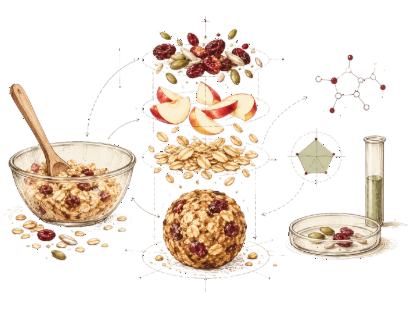
What actually makes a food "better"? Students pick a real, specific need (improving nutrition, supporting the microbiome, accommodating a health condition, reducing environmental impact, or making healthy food more affordable), then dig into the science of digestion, nutrient use, microorganisms, and genetically modified foods before designing an actual product. The result has to hold up to more than a taste test: real evidence, real safety standards, real cost, and real people's needs.
How this challenge is structured
See the full week-by-week breakdown ↓
Health for Life (PPZ3C) - Explore wellness, health conditions, and food access - what real gap in someone's diet or health actually needs solving.
What food-related need is real, specific, and worth solving?
Science (SNC4M) - Introduce nutrition and digestion basics - how the body actually uses what it eats.
What does the body actually need, and where do most foods fall short?
Business (BEP2O) - Begin user research. Talk to a specific group about a real food-related frustration or unmet need.
What do people actually say is missing, versus what we assumed?
Computer Science (ICD2O) - Explore existing food and nutrition products/data tools to see what's already been tried.
What's already out there, and where does it fall short?
This week produces:
A validated need statement - a specific person or group, and a specific gap.
Where each subject shows up
| Subject | In this challenge |
|---|---|
| Health for Life (PPZ3C) | Nutrition needs, wellness, health conditions, and food access |
| Science (SNC4M) | Digestion, nutrient metabolism, microorganisms, genetically modified foods, and effects on organs and long-term health |
| Business (BEP2O) | Cost, affordability, and getting a food product to real people |
| Computer Science (ICD2O) | Data tools for nutrition analysis and tracking product iterations |
Ends in…
A public tasting and demo of the final product, backed by the evidence behind its claims
Portfolio evidence
Nutritional analysis, product iterations, a cost model, and documented taste-test feedback
Real credit
This challenge counts toward PPZ3C, SNC4M, BEP2O, and ICD2O - real Ontario high school credits, not just enrichment. This challenge includes Grade 12 Science (SNC4M) - Mosaic students who are ready move into upper-year credits while still in Grade 9 or 10.
Every challenge is built on Ontario Ministry-recognized courses delivered through TVO ILC on our schedule.
Design food that holds up to real evidence - and earn the credit that proves you did the work.