Grade 9–10 · Term 2 Challenge
Can We Safely Engineer Earth's Climate?
If cutting emissions isn't enough, should humanity deliberately cool the planet?
Term 2 · December–March
Overview
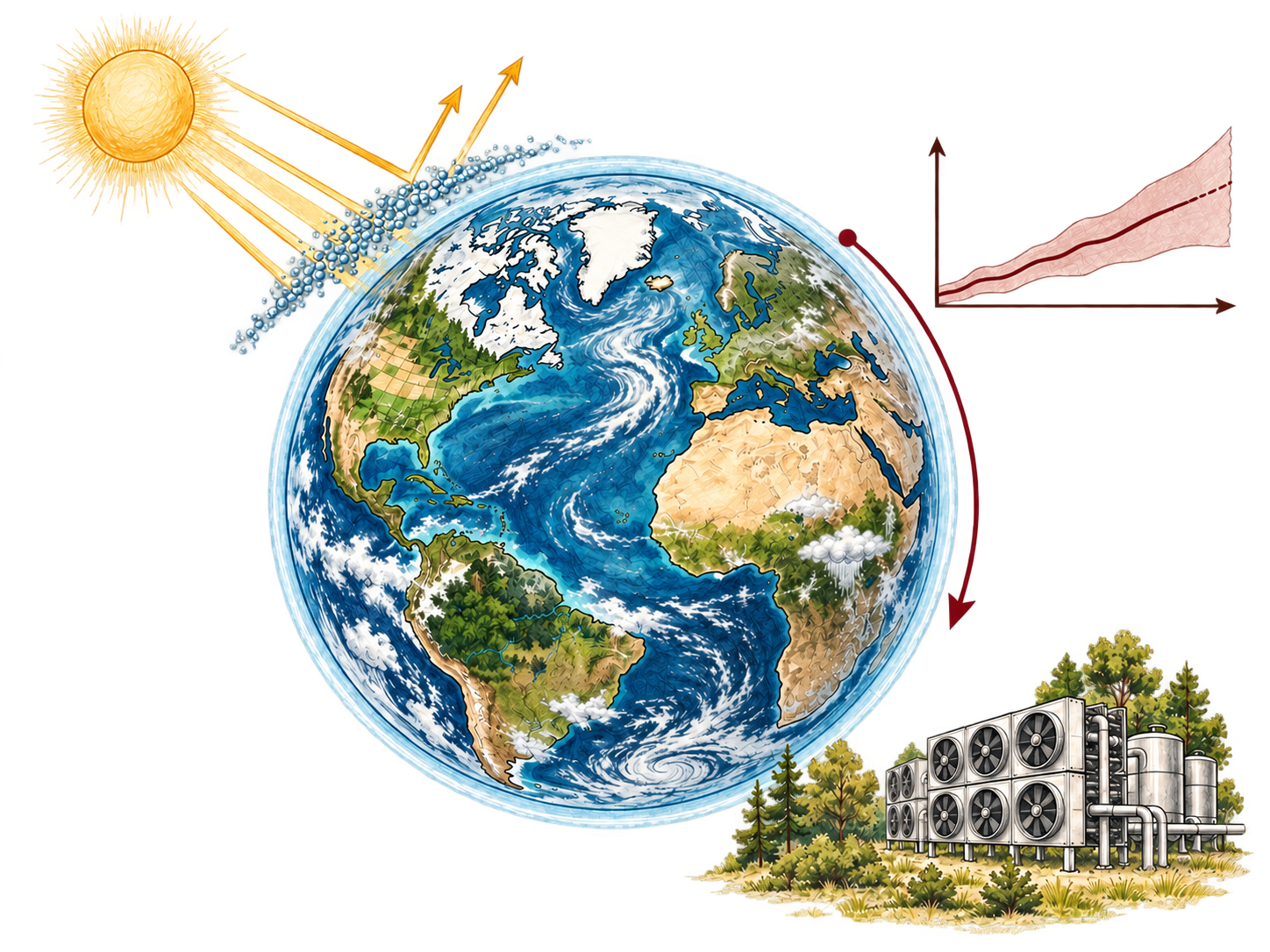
It's 2045. Global temperatures keep rising despite major emissions cuts, and an international climate council wants an answer: should humanity deliberately intervene in the climate — removing carbon from the atmosphere, reflecting sunlight back into space, or neither? Student teams dig into the real science of how Earth regulates its temperature, build mathematical models of possible interventions, and weigh benefits against real risks and unequal consequences before making — and defending — a recommendation. This isn't presented as a problem with an obviously right answer: the uncertainty and the trade-offs are the point.
How this challenge is structured
Phase 1
Investigate
Understand Earth's climate system and identify the mechanisms actually causing warming.
Phase 2
Model and test assumptions
Build simplified mathematical models of possible interventions, then compare predictions, uncertainties, and unintended consequences.
Phase 3
Decide
Choose an intervention strategy — or recommend none at all — and justify it with evidence.
Phase 4
Defend
Present the recommendation to a simulated international climate council and respond to real challenges to the reasoning.
Where each subject shows up
| Subject | In this challenge |
|---|---|
| Science (SNC1W/SNC2D) | How Earth's climate system actually regulates temperature — greenhouse gases, heat transfer, and human influence on climate. |
| Math (MTH1W/MPM2D) | Building and comparing mathematical models of intervention scenarios — rates of change, linear and quadratic relations, and what a model can (and can't) tell you. |
| English (ENG2D) | Building an evidence-based argument and defending it under real, live questioning. |
| History (CHC2D) | How societies have responded to large-scale technological and environmental risk, and who holds the power to decide for everyone. |
| Computer Science (ICD2O) | Turning mathematical models into working simulations, and visualizing what they predict. |
Ends in…
A Global Climate Intervention Summit, where teams present their recommendation to a panel — and may have to revise their position on the spot if new evidence is introduced mid-presentation.
Portfolio evidence
An international climate intervention proposal: supporting models and graphs, expected benefits, major uncertainties, possible unintended consequences, cost and resource trade-offs, governance and ethical considerations, and the conditions under which the team would stop or reverse the intervention.
Real credit
This challenge counts toward SNC1W/SNC2D, MTH1W/MPM2D, ENG2D, CHC2D, and ICD2O - real Ontario high school credits, not just enrichment.
Built for Grade 9 and Grade 10: This challenge scales to whichever course a student is actually enrolled in — the same real-world problem, with science and math that meet each student at their own grade.
Every challenge is built on Ontario Ministry-recognized courses delivered on our schedule.
When the trade-offs are the point, students learn to decide under real uncertainty — and defend it.