The science
Learning that lasts is built in the brain—not the lesson plan alone.
Mosaic's model follows how memory actually forms: spaced return, mixed practice, and retrieval that strengthens the pathways back to an idea over time.
By "reactivation" we mean bringing an idea back to mind — in class, in a project, or, as the brain does on its own, during sleep.
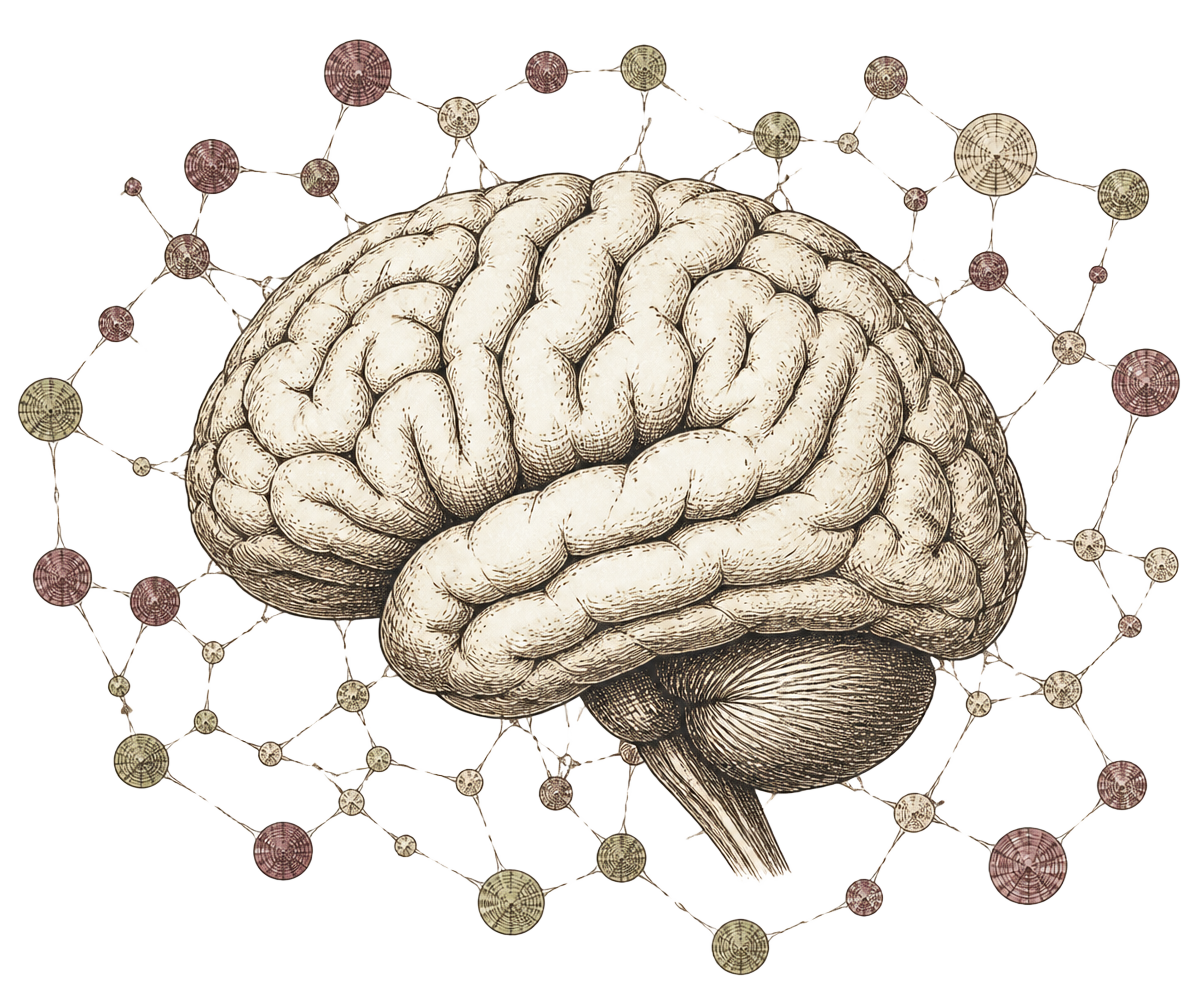
Ideas stick when circuits fire again.
Inside the brain
Three mechanisms we design around
Curriculum is the surface. Underneath, we are aiming at plasticity, consolidation, and flexible schemas—so knowledge survives the test and shows up when life asks for it.
01
Synaptic plasticity
Connections that fire together wire together
When one neuron repeatedly helps fire the next, the connection between them strengthens. This is long-term potentiation (LTP), first recorded in the hippocampus in 1973 and still the best-supported cellular candidate for how memories are stored (Bliss & Lømo, 1973). Strikingly, the same rule holds at the synapse itself: spaced bursts of stimulation produce stronger, longer-lasting LTP than the same stimulation delivered all at once (Scharf et al., 2002; Kramár et al., 2012; see also Smolen, Zhang & Byrne, 2016). Each spaced return of an idea gives that pattern of connections another chance to strengthen.
02
Systems consolidation
From fragile to durable over time
New learning depends heavily on the hippocampus. Over time—and especially during sleep, when the hippocampus replays recent experience to the cortex—the cortex builds its own version of the memory, and the general pattern comes to depend on the hippocampus less (McClelland, McNaughton & O'Reilly, 1995; Diekelmann & Born, 2010). How complete that handover is remains an open question, but the direction is well established: spaced, repeated return is what gives cortex the opportunity to learn.
03
Schema & transfer
Networks that recognize the pattern next time
The brain stores meaning in overlapping networks, not isolated facts. When new information fits a framework the learner already holds, cortex can absorb it far faster than usual (Tse et al., 2007), with medial prefrontal cortex helping match new material to existing schemas (van Kesteren et al., 2012). Transfer to new problems is notoriously hard to produce. The most reliable route is exactly the one Mosaic takes: meet the same structure—cells dividing, then compound interest—across several distinct contexts, so the abstraction, not the surface, is what gets learned (Gick & Holyoak, 1983).
Cognitive & neural science
What the evidence points to
Durable learning depends less on how hard you study in one sitting, and more on how often, how far apart, and in what form an idea comes back. These four levers map cleanly onto Mosaic's week-to-week design.
01
Reactivation & consolidation
Spaced return
The forgetting curve is real: memory drops steeply after a single exposure (Ebbinghaus, 1885; replicated by Murre & Dros, 2015). Returning to an idea once some forgetting has set in strengthens memory more than the same amount of practice packed into one session—a result confirmed across 254 studies (Cepeda et al., 2006). The best gap grows with how long you need to remember: material needed a year from now is best revisited over weeks and months, not days (Cepeda et al., 2008). Spacing is not busywork; it is how the brain stabilizes what matters.
At Mosaic · An exponential appears in math, then biology, then a challenge, then economics—each visit spaced so the memory has time to settle and return stronger.
02
Discriminative contrast
Interleaving
Practicing one problem type in a block feels fluent, but students never learn to recognize which method a problem calls for. Mixing related problem types forces that choice every time. In a preregistered randomized trial with 787 Grade 7 students, interleaved practice lifted scores on an unannounced test a month later from 38% to 61%, a large effect (Rohrer, Dedrick, Hartwig & Cheung, 2020). Interleaving helps most when ideas are easily confused with each other (Brunmair & Richter, 2019)—exactly the case when a real problem does not announce which chapter it came from.
At Mosaic · Within a unit, problem types are mixed so students must identify the approach before they apply it. Across subjects, math, science, and challenges share themes on purpose, so the same structure shows up wearing different clothes.
03
Retrieval practice & elaboration
Retrieval & teaching
Pulling knowledge out of memory—explaining, modelling, teaching—does more for retention than re-reading, even when re-reading feels more productive (Roediger & Karpicke, 2006; Karpicke & Blunt, 2011). Retrieval strengthens the route back to the idea; putting it into your own words connects it to what you already know and makes gaps visible. Teaching works through the same channel: students who taught material without notes learned more than those who taught from them, which suggests the benefit runs largely through retrieval (Koh, Lee & Lim, 2018). Retrieval works best when followed by feedback, so gaps get corrected rather than rehearsed.
At Mosaic · Challenges, presentations, and science-fair teaching turn students into the ones who retrieve and reshape the idea—not just review it.
04
Metacognition & self-regulation
Learning how to learn
Left to themselves, students reliably choose the study strategies that feel productive over the ones that work—re-reading over recall, one long session over several short ones (Karpicke, Butler & Roediger, 2009; Bjork, Dunlosky & Kornell, 2013). Teaching them directly how memory works, how to plan a block of work and how to check whether they really understand something raises achievement across subjects, and the gains persist after the teaching stops (Dignath & Büttner, 2008; de Boer et al., 2018).
At Mosaic · Twenty minutes of mindset coaching a day, scheduled right before independent work, so a strategy gets used within minutes of being learned.
How Mosaic builds it in
One idea. Five returns. Stronger each time.
Watch an exponential move through the year. Each encounter brings the idea back after a gap, adds a new context, and asks for retrieval first—spacing, variation, and teaching in one arc.
- 1
Math class
y = 2ˣ
- 2
Biology
cells dividing
- 3
Cancer challenge
where the model breaks
- 4
Economics
compound interest
- 5
Science fair
teaching it
Each return asks students to retrieve the idea before they extend it.
Grounded, not gimmicky
Research we stand on
We are not inventing a trendy learning hack. Mosaic is shaped by well-replicated findings in memory and learning science—translated into a school day students can feel.
Spacing effect
Spaced practice beats massed practice for long-term retention in a meta-analysis of 254 studies spanning more than a century of research (Ebbinghaus, 1885; Cepeda et al., 2006).
Testing effect
Retrieving information strengthens memory more than restudying it, and the advantage grows with delay (Roediger & Karpicke, 2006; meta-analysis: Rowland, 2014). Rated one of the two highest-utility study techniques in a major review (Dunlosky et al., 2013).
Interleaving
Mixing related problem types improves later discrimination and transfer versus blocked drills, with the largest gains when items are easily confused (Rohrer & Taylor, 2007; Rohrer et al., 2020; meta-analysis: Brunmair & Richter, 2019).
Desirable difficulties
Bjork's framework: conditions that feel harder in the moment—spacing, variation, retrieval—often produce stronger lasting learning, even though learners rate them as less effective (Bjork, 1994; Bjork & Bjork, 2011).
Sleep & consolidation
During sleep the hippocampus replays recent experience to the cortex, and sleep after learning reliably improves retention (Diekelmann & Born, 2010; Rasch & Born, 2013). The school day is not the only place memory is built.
Mindsets, at their real size
Teaching students that ability grows with practice produces small average gains—about d = 0.08 across 43 intervention studies—that are larger for students who are struggling and depend on whether the classroom culture backs the message (Sisk et al., 2018; Yeager et al., 2019). Two 2023 meta-analyses in the same journal reached opposite verdicts on whether the effect survives quality controls (Burnette et al., 2023; Macnamara & Burgoyne, 2023). We treat that as the honest state of the field: a real but modest effect that works only when it changes what students actually do.
Mindset coaching
Mindsets we train—and how long the effects last

A mindset is a belief about how learning, effort or stress works, and a small number of them have been tested in randomized trials with teenagers. The pattern in that research is consistent. The interventions are short: two 25-minute sessions in the national growth-mindset trial (Yeager et al., 2019), eight 25-minute sessions in the classic Grade 7 study (Blackwell, Trzesniewski & Dweck, 2007), about 30 minutes in the stress-mindset trials (Yeager et al., 2022). The effects last far longer than the sessions: higher grades across the whole school year and more students choosing advanced math the following year (Yeager et al., 2019). In a handful of studies the effects have been traced for years—three years of higher grades after a one-hour belonging exercise, and better career and life satisfaction seven to eleven years later (Walton & Cohen, 2011; Brady et al., 2020)—though those long follow-ups come from university students, not secondary schools, and the effects were concentrated in students who had felt they did not belong.
Why would an hour matter years later? The leading explanation is that a mindset changes how a student interprets the next hard moment—a low mark, a confusing lesson, a racing heart before a test—and that interpretation changes what they do next, which changes the moment after that (Yeager & Walton, 2011). The same research is clear about the limits. The effects depend on a school environment that backs the message (Yeager et al., 2019). Praising effort without teaching better strategies, sometimes called a "false growth mindset", does not help and can backfire (Yeager & Dweck, 2020). And no one has tested daily mindset training at the dose we run, so we designed the block around what has been tested: each mindset gets a two-week unit—roughly the three hours of contact that the trials used—then is retired from the daily session and kept alive in how teachers give feedback and how students plan their work. New units rotate in every couple of weeks.
Abilities grow with the right practice
Intelligence and skill develop through effortful practice, better strategies and asking for help—not effort alone. Taught with the emphasis on strategies and help-seeking, which is what separates the trials that worked from the ones that did not (Blackwell, Trzesniewski & Dweck, 2007; Yeager et al., 2019; Yeager & Dweck, 2020).
Stress can be a resource
A racing heart before a presentation is the body delivering oxygen to the brain, not a sign of failure. Reappraising stress this way improved test performance in adults and, combined with a growth mindset, lowered teenagers' cortisol, reduced anxiety and improved grades across six randomized experiments with 4,291 students (Jamieson et al., 2010; Crum, Salovey & Achor, 2013; Yeager et al., 2022).
Everyone struggles to belong at first, and it passes
Feeling out of place in a new school is normal and temporary, not evidence you don't fit. The longest-lasting effects in the mindset literature come from this idea, including a 2023 trial across 22 universities (Walton & Cohen, 2011; Walton et al., 2023).
Learning has a purpose beyond you
Connecting schoolwork to a goal that matters to other people—a family, a community, a problem worth solving—increased teenagers' persistence on tedious tasks and raised their grades (Yeager, Henderson et al., 2014).
Ask "what could I do differently?"
A strategic mindset is the habit of looking for a better method when something isn't working, rather than trying harder at the same thing. Students who held it earned higher grades, and a brief exercise increased how often they used new strategies (Chen et al., 2020).
Mistakes are information
Errors, followed quickly by feedback, are among the most effective learning events there are (Metcalfe, 2017). In one study, students with a growth mindset showed a larger brain response to their own errors and corrected more of them—a correlation, not a cause, but a useful picture of what "paying attention to mistakes" means (Moser et al., 2011).
Plan like a scientist
Naming a goal, picturing the obstacle most likely to get in the way, and deciding in advance what to do when it appears. Taught to high-school students, this doubled the number of practice questions they completed (Duckworth et al., 2013).
Be as fair to yourself as you would be to a friend
Self-compassion after a setback is associated with lower anxiety and depression in adolescents and, in adults, with more motivation to improve rather than less (Marsh, Chan & MacBeth, 2018; Breines & Chen, 2012). The evidence here is mostly about wellbeing rather than grades, and we say so.
Two weeks per mindset. The rest of the year to use it.
What we claim and what we cite
What we don't claim
The behavioural effects above are among the most replicated in psychology. The neural mechanisms are our best current understanding of why they work, and that understanding is still being refined; we describe them as candidates, not certainties. We do not claim that a mindset message on its own changes grades; the evidence for that is real but small, which is why our mindset block is mostly about learning strategies and why each mindset is taught at roughly the dose the trials used. We do not build on learning styles, left-brain/right-brain teaching, or "brain training" apps—none of which has survived controlled study (Pashler et al., 2008; Simons et al., 2016).
Mosaic's curriculum lead holds a master's in neuroscience and has spent years applying her research to teach and coach teens.